Year: 2025

  • “What’s the WIFI” + Alarm Clock

    “What’s the WIFI” + Alarm Clock

    My neighbor runs a little vacation rental and is always forgetting the password for the guest WIFI. It seems that sticky notes are just too easy to lose, so I set out to make something a little more permanent to keep the login info on. Since I was going to the trouble of making something, I tried to add a little touch of fun to the design. As you will see, the final design ended up taking on a life of its own, spurring a second project and then dreams of something bigger.

    The Plan

    I broke the design into two parts, one for function, and the other for fun. The principal function would be served by a 3D printed plaque inscribed with the login info as well as QR code that can be scanned to automatically logon. The fun part would be an eye-catching stand for the plaque that would draw in the user and bring a pop of style to the room.

    The design of the stand was based around my neighbor’s personal tastes. I drew inspiration from his love of the American 60s: a time of color TV, groovy fashion, and hippies. To channel this I brough in bright colors, a corduroy texture, and a splash of psychedelic style.

    Drafting

    The CAD for this model was simple, so I’ll dive into the methodology more than usual. The process started with drawing the cross-section of the plaque and the stand as spline curves.

    The next step was drafting the side profile. Having already roughed out two side profiles in the ideation phase, I picked the second option.

    With the curves complete, I could start to build the surfaces. I made all the straight sections by extruding the existing curves. The bent surfaces were made by blending between extruded surfaces.

    From there I just needed to lay up the text and QR code for the plaque, and voila!

    Nice.

    From the beginning of the drafting process, I was planning to experiment with the surface blend tool. A more conventional approach might have been to use a tool that’s guaranteed to preserve the cross-section, like a “sweep.” I felt a sweep was too stiff in this case, as it wasn’t producing the side profiles I wanted for the bent surfaces. In this case, the surface bend did well enough at preserving the cross-section around the bend with minimal manual adjustments from me. I think this model is a nice example of how a design can grow naturally from thoughtfully planned NURBS geometry. From this, I’d expect the style of this model to be easily repeatable. Corduroy for all!

    Reception

    My neighbor was totally psyched. He loved the shape, colors, functionality, the whole deal. Here’s how it looks in the rental:

    He noted that guests seemed to like it too. He mentioned this matched the changing trend in his guest’s preferences. He explained that guests now want to be autonomous during their stay and he lamented the loss of personalized hospitality. Soon he was coming up with all kinds of ideas of uses for these little plaques around the rental, such as having a QR code to an online self-check-in. An interesting project I might come back to another time.

    Alarm Cock

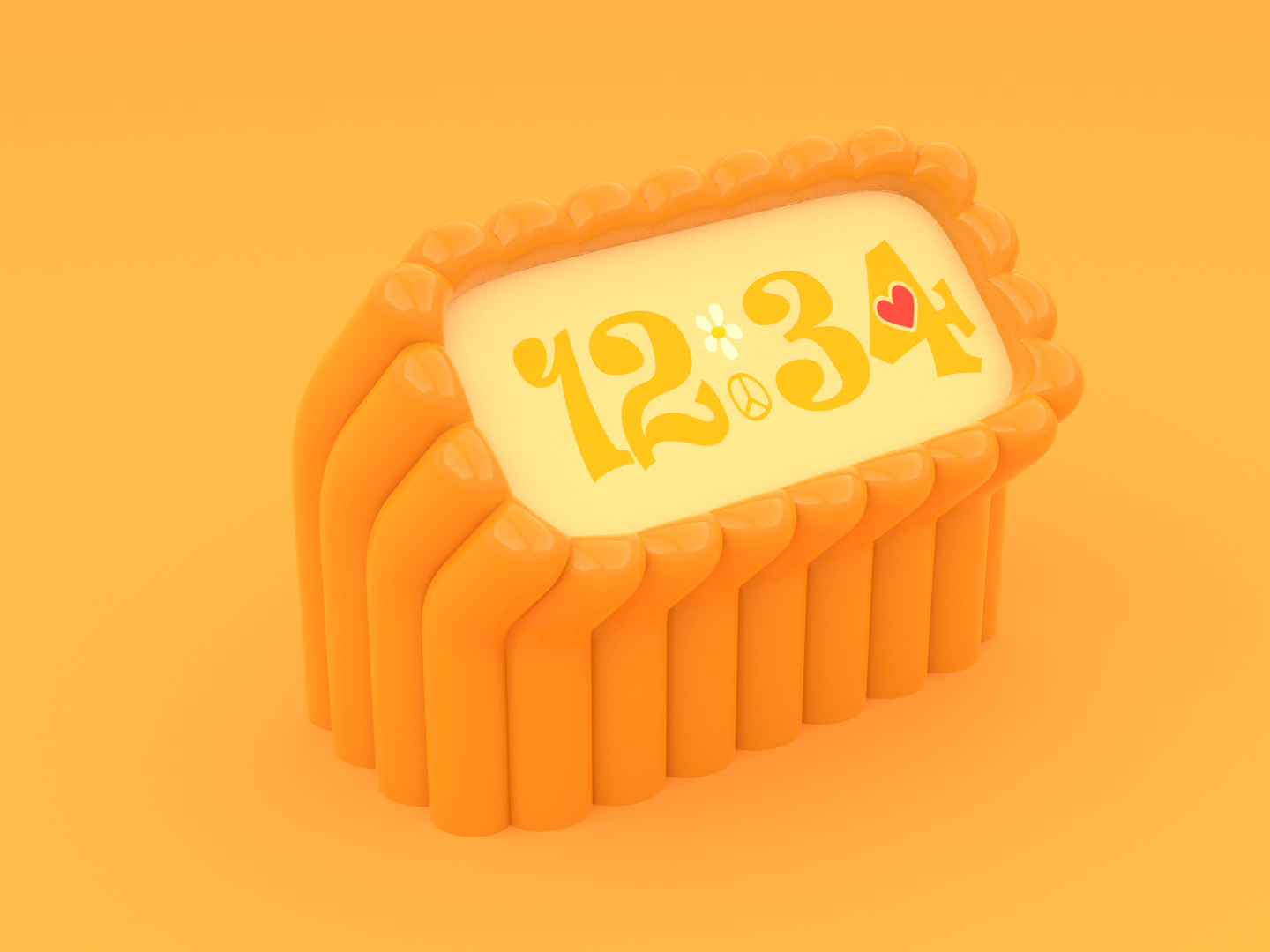
    Riding high off my neighbor’s enthusiasm, I found myself wondering what else I could do with this design. I tossed a few ideas around for it and decided it could make one groovy alarm clock.

    I drew a few stylized clock faces to see what worked.

    I liked the option 3 the best, so I did a full render for it. Here’s how it came out. Go ahead and give it a spin!

    your 360 images

    I also experimented a bit with using AI to render the alarm clock in a bedroom. I supplied my render of the alarm clock then described the rest of the scene. The results incorporate the clock surprisingly well.

    It might be fun someday to try and get a full prototype of this up and running.

    Corduroy Joy

    This project was a joy to work on. Starting with a tiny scope, and a concise need was a comfortable place to start, and by the end I found myself wishing I could keep working on it. The positive feedback from my neighbor was a green light for more development. And his suggestions for other uses in the rental could justify making a whole bunch of objects in this style. My alarm clock idea supports another functionality for this fun design. Considering how simple the CAD workflow was for this project, more is sure to come.

    That’s all for now!

  • Tessellating Art and the Einstein Problem

    Tessellating Art and the Einstein Problem

    I set out to blend the mathematics that solved the Einstein Problem with the artistic style of M.C. Escher. Follow along as I recount my creative process and display my art.

    The Einstein Problem

    The Einstein Problem is solved by a tile. The shape of that tile, or if it even existed, was a longstanding problem in mathematics. Then in 2022 a solution was discovered, and in 2023, published.

    The Einstein Problem asks if there exists an “aperiodic monotile”.

    1. Tile: It covers a plane without gaps.
    2. Mono: The tiles are all the same shape.
    3. Aperiodic: It can’t have translational symmetry.

    When the solution was published, the mathematics community was ecstatic. However, detractors were quick to point out that the solution was technically incomplete. This controversy ended when the same researchers discovered and published a second solution.

    The announcement of the first solution spurred on a wave of tessellation art. News of the discovery entered the mainstream and tasteful mosaics abound. The second solution, mired in controversy, and arriving well after the hype, earned little fan art. It’s sad. The second solution is more elegant, storied, emotional, than the first.

    Specter

    That second solution was named “Specter” by its discoverers. Specter isn’t Just a single tile thought, it’s a whole family of tiles. There’s an infinite number of Specter tiles, and this makes it flexible enough to stylize. I’ve created a few examples to clarify what I mean.

    (Left) A Specter with stylized edges. (Center) A Specter with standard edges. (Right) A specter with stylized edges.

    A tessellation of Specters. The animation fades between differently stylized edges.

    Getting Hands On

    The initial discovery was made by David Smith, a retired print technician and self-identified “shape enthusiast.” In his pragmatic methodology he used software to design tiles and then tested them in the real world by cutting them out of paper. Smith has talked about the moment of discovery. He describes laying down the paper tiles, one after another. As he laid down the tiles, he recounts the strange feeling, as each fit into the next without any pattern. I wanted to understand that feeling.

    Instead of cutting the tiles from paper, I would use my own medium, 3D printing. There are countless decorative variations published online, so I browsed for a bit and picked my favorites. Here are the mosaics I made with those tiles:

    Mosaics made with 3D printed monotiles.1

    Outside of a computer, I was free to place tiles however felt natural. As I placed tiles, I kept trending into repeating motifs. The aperiodic tile resists this. The only way to make a repeating motif with an aperiodic tile is to leave occasional gaps between tiles. Only an aperiodic mosaic will close the gaps.

    Making an aperiodic mosaic feels strange. Without a visual pattern to guide tile placement, it’s unclear where the next tile belongs. The tiles can’t be placed randomly however, otherwise you’ll end up with unfillable gaps. There’s a single pattern that all Specter tessellations follow. Each additional tile has a place.

    Controversy revisted

    Leaving gaps between tiles is an ‘illegal’ move in the world of mathematical tessellation. I’m reminded of another move that’s natural in the real world, but significant in math: flipping a tile over. I mentioned before that there was some controversy surrounding the first published monotile solution. When David Smith was testing his tile design with paper tile cutouts, a few of his paper tiles were upside down. When a tile is flipped over, is it the same shape? That was the subject of the controversy surrounding the first publication. The second publication, Specter, doesn’t require any flipped tiles.

    The first monotile publication had found a spectrum of solutions. At the center of that spectrum is Tile (1,1). That central tile, coincidentally, is a Specter tile. It simply took some time for the research team to realize the significance of Tile (1,1). In the end, the partial solution led to the complete one. If Smith hadn’t flipped over that paper tile, would there be a Specter?

    Making Specters

    After playing with tiles designed by other people, I wanted to make some of my own. Perhaps because I have a soft spot for the strange, I wanted to do it with the lesser-known Specter.

    Unfortunately, there’s few options for working with Specter. Nearly all of the tools and art I found build off of the first published tile, not the second. After a long search, I found this forum thread. It’s a veritable gold mine of Specter art and software. I modified another user’s script to allow custom tile designs and started to play around. The way a design flows between Specters is hard to describe. There’s a lot of order and chaos to it. This would inspire the decorations that I designed.

    (First) A single decorated tile that’s used to tessellate the plane. (Second) A glimpse of the grasshopper script used.

    Art Gallery

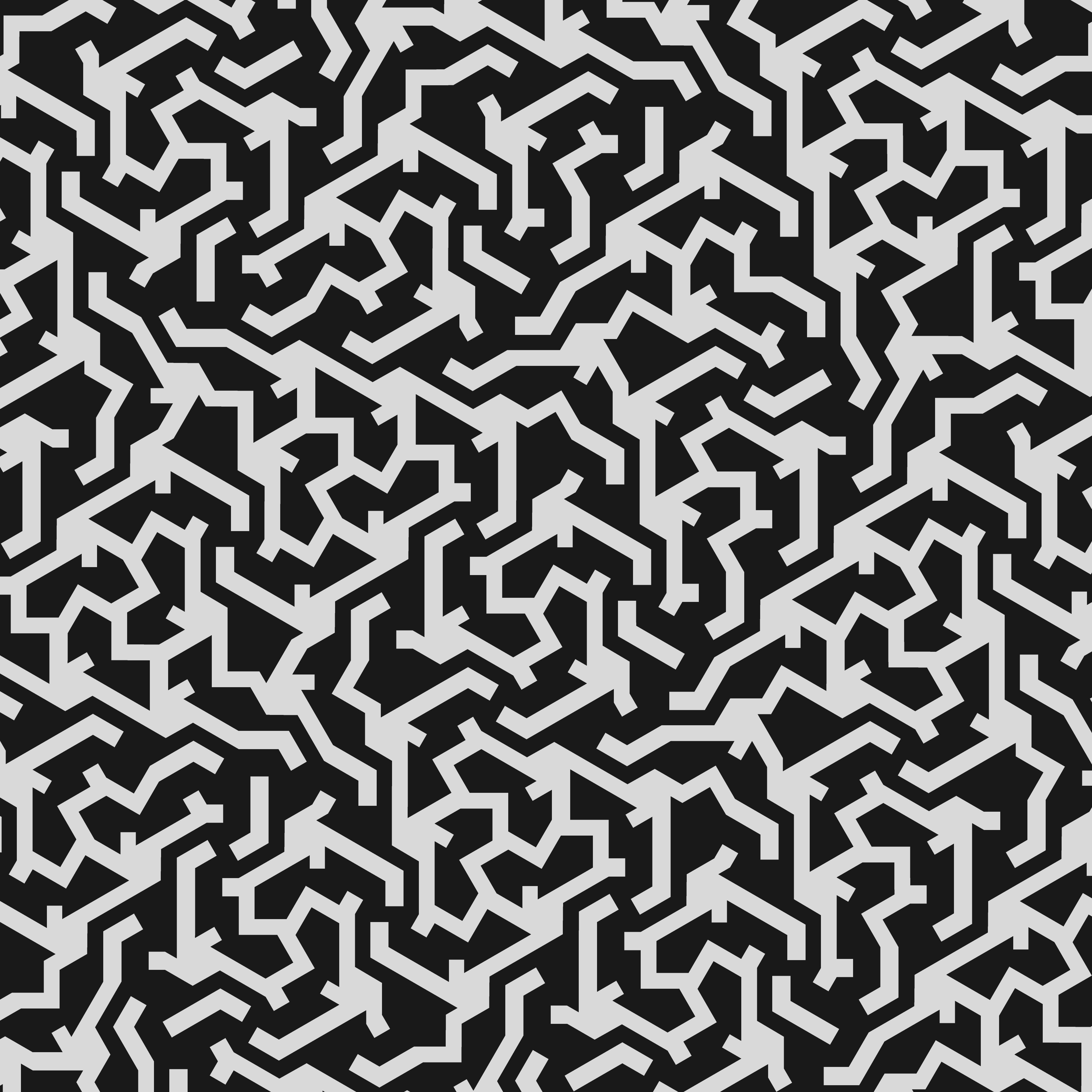
    The following mosaics are made by decorating a single Specter tile, then tessellating it. The aperiodic tessellation of Specter it may appear chaotic, but it is ordered. In this artwork I attempted to capture that feeling of order from chaos. Individual tile decorations are abstract, and only when tessellated dose a structure emerge. What structures do you see?

    Untitled #1

    Untitled #2

    Untitled #3

    Untitled #4

    Untitled #5

    Untitled #6

    Repetition Emerges

    As the tessellation expands, repeating patterns start to appear. This is strange because the tessellation lacks translational symmetry. A repeating motif shouldn’t be possible. What’s especially strange is that these patterns are imperfect — ghost like. For an example of what I’m describing, look for triangles in the large version of untitled #4.

    Untitled #4, Large

    It took some research, but I think I know what’s going on. When Specters are tessellated, they organize into small groups. These small groups tile in the same way as hexagons.

    Animated fade between tessellated Specters2 and tessellated hexagons.

    According to the seminal paper on Specter, there is always an equivalent tessellation of hexagons. However, the hexagon tessellation and the Specter tessellation never perfectly align. This is both the reason for orderly patterns that emerge, and also why they’re imperfect.

    I had designed the tile decorations to create meandering structures. I imagined the tiles would tesselate into an endless maze. What I had not anticipated was this emergent symmetry; that it looks orderly as the tessellation expands.

    Something new, something old

    A public sculpture inspired by tessellation art of M.C. Escher.3

    For 800 years the Alhambra has stood atop the hill in Granada, Spain. At one time it was a simple stronghold, then an Islamic palace. After the Reconquista, the Spanish king took it for himself. It was in the Alhambra that Cristopher Columbus received a royal endorsement for his expedition to the new world. By the 1500s the Renaissance was in Spain, and the Alhambra was not a Renaissance palace. Construction of a new palace began.

    The kings that occupied the Alhambra added to it. A fountain here, a mosaic there and over time the walls became dense with ornamentation. The style might have been old, but the beauty was undeniable. When the new Renaissance-style palace was completed, the old one was not demolished, it was simply abandoned. The immaculately decorated halls of the Alhambra went quiet.

    1936 M.C. Escher began to explore the empty Alhambra. Escher was a little-known artist at the time. His work was unremarkable, capturing the world as it appeared to the human eye, a style popularized in the Renaissance. He took a special interest in the ancient building, especially its mosaics. For a time, he was obsessed. He worked feverishly to document and study its tessellations.

    After this study, Escher’s work changed. He blended what he saw in the Alhambra with contemporary techniques. He found his style, his legacy. To this day, he is known for his mathematical and tessellating art.

    When I set out to make art with the aperiodic monotile, I did so with good company. My journey was made possible by those who came before me. Like them, I made something new with something old.

    Citations

    1. 3D modeling authorship for these 3D printed tiles are @bengineering on Thingaverse, @ateldsign on Printables, @ateldsign on Printables, @CarlosLuna on Printables. ↩︎
    2. This diagram comes from the paper “A chiral aperiodic monotile” by David Smith, Joseph Samuel Myers, Craig S. Kaplan, and Chaim Goodman-Straussis. It’s released under the CC BY license (International 4.0). My modifications to the diagram are shared alike. ↩︎
    3. Photograph by Bouwe Brouwer. It’s released under the Creative Commons Attribution-Share Alike 3.0 Unported license. ↩︎