My dog Juniper has a lot of drive. She’s built to run, but me, not so much. We meet in the middle with a bike. Our setup is like a dog sled with wheels: paw to ground, foot to petal. Together we pound trail and eat miles.
Our arrangement broke down when I moved to Sweden. The busy bike lanes were nothing like the logging roads we were used to. Bikes, mopeds, cars, all these obstacles required us to be nimble. My old gear was perfect for speeding through forests, but terrible for agility. I needed something different.
Over the next few months, I developed a new way to connect dog, rider and bike. Taking inspiration from the cowboys of the wild west, I brought the saddle horn to the bike.

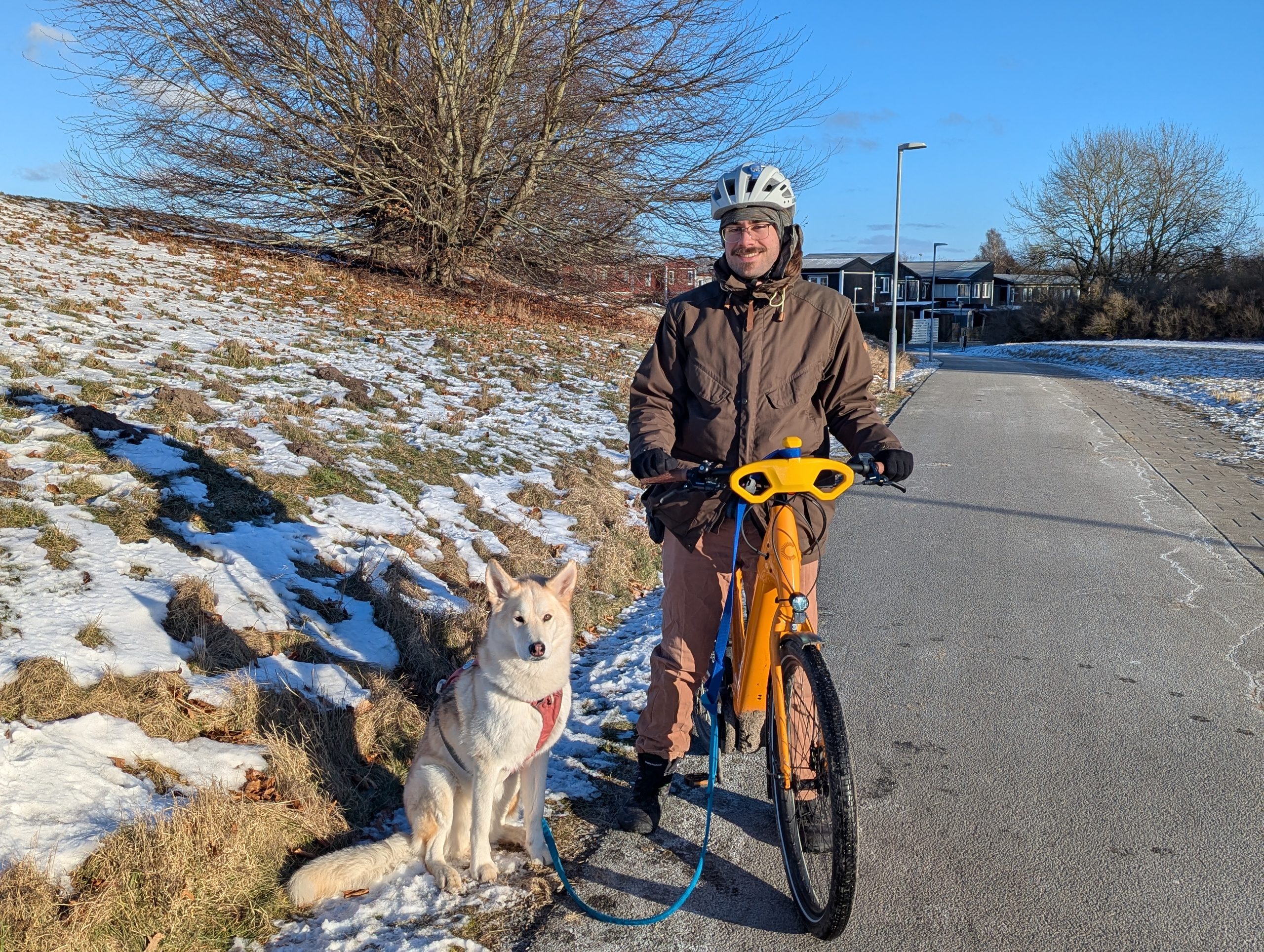
Me riding with Juniper. The saddle horn (in blue) is mounted on the handlebars.
The problem
My old setup is for a sport called dogjoring. Its is a competitive sport, and the gear is built to match. The dog is fitted with a pulling harness and lashed to the bike with a long line. The line runs through a loop extending off the handlebars, keeping the line off the wheel and the dog out in front. The net result? Power.
This system wins races, but at the cost of control. Aside from hitting the brakes, the rider has zero physical control over the dog. I think you can see where this is going. No matter how good Juniper is, vocal commands alone just weren’t enough to navigate busy streets.


Various images of a my dogjoring setup.
The Solution
Essential for high speeds, the long line was non-negotiable. It might have been easier to switch to a short lead, but where’s the fun in going slow? What I really needed was a way to manage all that extra line between sprints.
I pulled from my past experiences managing lines in tight spaces: Sailing and horseback riding. In short order I put together an idea board and got to sketching.


The concept is a saddle horn that attaches to a quick-connect on my handlebars. During sprints the tension on the line keeps things tidy. When we need to slow down and dodge obstacles, I can take up the slack or ene lift the leash off horn entirely. This means I can pull the leash around to position Juniper away from distractions and obstacles.
Validation
Layer by layer I watched the 3D printer build the first prototype. In no time we were out riding in the cool autumn air. With one hand steering the bike and the other on the leash, I found myself a bit overwhelmed. Both of us were still getting used to the new setup, but the concept was there.


Various images of the first version.
I had borrowed the quick connect idea from my old dogjoring setup, and I’m glad I did. The easy on-and-off meant I wasn’t stuck with this crazy thing on my handlebars all the time.
A short video of the saddle horn in locking into the quick connect.
A lot went right on this first attempt, but there was one big problem. When the line is slack, it falls too far down. Once it’s falls around the quick connect, it’s a struggle to lift back up. Details like this are hard to catch before the first prototype.

A 3-part demonstration of the line falling into the quick connect.
Refinement
With a solution in mind, I got back to work. I wanted to keep the system self-contained, so the fix had to be a part of the saddle horn. I sketched up my ideas and knocked out a prototype.


At this point the design was mostly functional. In addition to looking funny, there were only minor issues remaining (ex: it was a little wobbly in the quick connect). I rode this version for the next month or so, learning all its quirks. When I sat down to make the next version, I knew it would be the final one.
Being well into winter now, snow was thick on the ground. To freshen up the look, I took inspiration from the surrounding snow drifts. I sketched up some crude ideas and sat down to draft the final iteration. To capture some of that snowdrift-y look, I learned some new CAD techniques to create a soft crease. It was a bit of a struggle, but I think that front surface came out rather stylish.


Showcase
In the old system Juniper was forced out in front, but now she could do 360s around the bike. To keep things under control, we needed to stay synched. Over the winter we drilled new commands for positioning. Here’s a few of the formations that came in handy:


When we’re zipping around a barking dog or being passed by a speeding moped it’s hard to get a hand free to take a picture. However, in low-stakes scenarios It’s a bit easier to stop and get the camera out. Here’s some of those low-stakes scenarios where the system’s flexibility came in handy:


Man’s Best Friend
I’d like to end this with a story. Something that explains my motivation, why I do this. And that story starts with the little deer living at the edge of town.
These little deer, or as the swedes called them, rådjur, could be glimpsed ducking between hedgerows or grazing distant fields. They quickly became Juniper’s fascination. The mere sight of them would drop her into a predatory stance: hackles raised, head dropped, eyes locked. Any time this happened I’d drag my wannabe-wolf in the opposite direction, eventually breaking her out of it. Despite my best efforts, she would eventually get her way.
We were riding hard against the wind as we followed a muddy lane over the countryside. I could no longer feel the pelting of rain on my numb skin. I strained to see through the wind as tears welled in my eyes, there was something ahead. Standing still against the sweeping grey clouds were several silhouettes, a herd of deer.
We must have seen each other at the same time. I looked at them, they looked at me, and then then Juniper saw them. In that instant the bike kicked forward as juniper rammed herself against the end of the line. The deer bolted and I grabbed the brakes. The muddy ground was slick as butter on a hot day, and my fistful of brakes sent the bike into a wild skid. Yelling and kicking, I released the brakes as Juniper hauled us over the crest of a hill. On the slope below us, in full flight, were the deer. There I was nothing I could do to stop it, so I leaned into the handlebars. Mud flying, wind whistling, it took everything just to hold on.
At first, it was close, then the herd started putting in distance on us. Eventually, they disappeared over the crest of the next hill. With her tongue flapping and eyes glimmering, Juniper finally looked back at me, and all I could do was laugh.

Juniper resting in a field of wild daises.